
How to plan a demo using our demo blocks framework.
We just finished a deep dive into our demo conversion data at Auditory, and the single biggest mistake founders/sellers are making is still feature dumping on their prospects.
We're seeing a direct correlation with screen sharing more than 30 minutes and a decline in win rate. (More to come on this in our end of year report - Subscribe and we'll send it to your inbox)
Too many founders and sellers jump into demos without a plan. This is insane! A demo is not a product tour, it’s a continuation of your discovery call. Your goal is to show how your product solves their specific problems, not just show your product.
Yes, you may have repeatable elements and familiar talk tracks. But every demo should be tailored. The way to make this repeatable is to build Demo Blocks.
What’s a Demo Block?
A demo block is a self-contained segment of your demo that covers:
- A feature/Service
- The advantage it provides
- The benefit to the prospect’s specific situation
- A short proof point or example
Think of these blocks as Lego pieces.
You do not need all your blocks every time.
You select the blocks that directly map to the prospect’s use cases, pain, and goals.
Some blocks aren’t screen-share moments. They might just be important topics you need to verbally address (privacy, onboarding, support model, integrations, etc.).
Example:
Feature: Call recording
Advantage: All sales call data is captured and stored
Benefit: Discovery call data can be used to create tailored demo plans that improve win rate.
See what I did there... but you get the point. :)
The Demo Plan Structure
Here’s the structure to use before every demo. I literally type this out in a note before the call for every prospect, (Auditory gives me all the data I need for the points to cover) and then I have it next to me as I demo. Literal checklist.
This ensures the demo builds belief instead of just showing features.
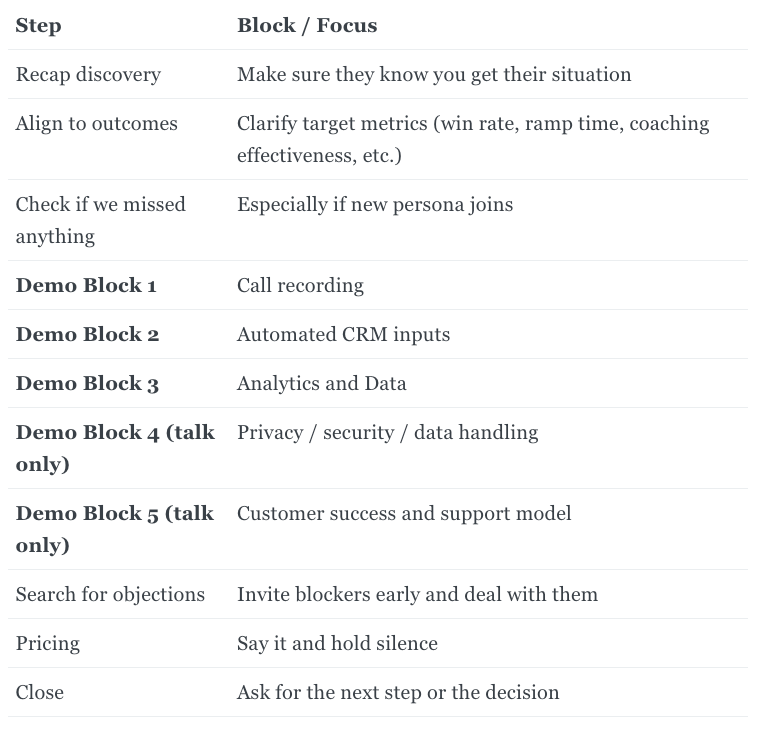
- Recap Discovery: Show that you understand their situation, pain, language, and goals.You want them nodding.
- Align to Outcomes: Confirm the metrics that matter and what “good” looks like to them.
- Demo Block 1 (core to the primary pain)
- Demo Block 2 (secondary use case / persona need)
- Demo Block 3 (reinforcement area / proof of broader value)
- Demo Block 4 (non-demo topic such as privacy/security/integrations — talk only)
- Demo Block 5 (onboarding, support, success — talk only)
- Pricing Overview: State it clearly.And then shut up. Silence is where the truth comes out.
- Close or Next Step: If you’ve earned it, close. If not, set a clear next step (proposal review, technical validation, etc.).
Search for Objections: Do this before they go quiet and stall the deal.Ask directly:
“What concerns or blockers are you thinking about at this stage?”
Check for New Context or People: If new stakeholders join, ask:
“Before we dive in, is there anything new that we should include so this is valuable for you?”
The key is that this has to be built around deep discovery. If you haven't found pain, you shouldn't be demoing!
In between all these blocks I'd recommend throwing in closed questions. Something like: You mentioned X was a challenge on your last call. Would this feature solve that problem?
Example Auditory Demo Plan
Key Principle
Discovery tells you what blocks to use.
Demo tells the story of business impact and change to the metric(s) they care about.
If your demo looks the same for every prospect, you’re not selling, you’re presenting.
This Demo Block method forces your to tailor directly to your buyer. I guarantee the results will speak for themselves if you deploy this.
Every founder and sales leader I speak with wants higher win rates and more consistent demos but most are still relying on memory and hope.
Auditory can support in surfacing the best pain points from your calls to build your demos around.