How to Build an Ideal Customer Profile (ICP)
A step-by-step operational framework for defining your first ICP hypothesis.
What is an Ideal Customer Profile?
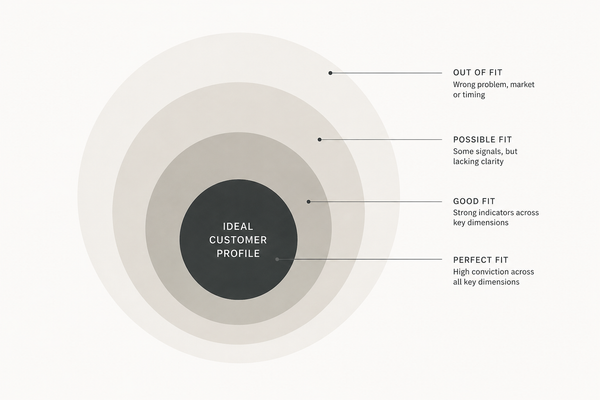
An Ideal Customer Profile (ICP) defines the type of organisation that gets the most value from your product or service and is the most likely to buy, stay, and grow with you.
This guide helps you build your ICP from scratch using seven simple but powerful sections. Each section includes prompts and space to complete your own answers.
Use this to sharpen your targeting, improve sales efficiency, and create alignment across your team.
When defining your Ideal Customer Profile, it’s useful to go beyond basic firmographics — the standard attributes like industry, company size, revenue, location, or tech stack. While firmographics tell you who a company is, exegraphics help you understand how a company operates. Think of exegraphics as the behavioural DNA of a business, how it executes its mission.
These could include things like a company’s hiring velocity, how data-driven it is, whether it prioritises innovation, or its typical go-to-market motion. The combination of firmographics and exegraphics gives you a much deeper lens: not just whether a company looks like a good fit, but whether it acts like one too.
How to Use This Guide
This guide is designed to help you build, or refine, your Ideal Customer Profile (ICP) from scratch. It’s practical, flexible, and built for real-world use.
Here’s how to get the most from it:
Step 1: Block 30–60 minutes
Grab a coffee, clear some space, and give yourself focused time to think deeply about who your best customers really are.
Step 2: Download the guide here, make a copy and Fill in each section
Each section includes:
- A clear definition
- Real examples
- Prompts to guide your thinking
- Space to write your own answers
You don’t need to get everything perfect. Start messy and refine later.
Step 3: Collaborate (if possible)
Share this with your sales, marketing, CS, or leadership team. Your ICP gets sharper when multiple perspectives are involved.
Step 4: Write your summary
At the end, you’ll write a simple sentence that captures where you win easiest, fastest, and most often, your North Star for targeting.
Step 5: Use it
Refer back to your ICP when:
- Qualifying leads
- Writing outbound messages
- Building playbooks or scripts
- Deciding who to prioritise
- Training new hires
1. Firmographics
Definition: The measurable characteristics of your ideal company.
Examples:
- Industry: B2B SaaS, EdTech, Healthcare
- Company size: 100–500 employees
- Revenue: $10M–$100M
- Region: UK, US, ANZ
- Tech stack: GSuite, HubSpot, Zoom
Prompts:
- What industries are your best customers in?
- What team size or revenue range do you serve best?
- Are there tech stacks or platforms your product integrates with?
Your Notes:
Industry:
Revenue:
Employees:
Tools used:
Geography:
2. Exegraphics
Definition: The behavioural and operational characteristics that reveal how a company executes its mission — how they work, think, and prioritise.
Examples:
- Fast hiring velocity (e.g. growing SDR team quickly)
- High marketing-to-sales ratio
- Recently made hire
- Invests heavily in product innovation
- Data-driven decision-making culture
- Follows a PLG or outbound-led go-to-market motion
- Agile, early adopter mindset
- Strong emphasis on operational efficiency
Prompts:
- What behaviours or internal strategies do your best customers tend to share?
- Are they growing, hiring, or launching new initiatives?
- How do they typically approach go-to-market, product development, or decision-making?
Your Notes:
Common internal behaviours:
Signs of high operational fit:
Cultural/strategic signals that align with your value prop:
3. Pain Signals / Triggers
Definition: Observable signals that indicate a customer is likely feeling the problem you solve.
Examples:
- Team hiring rapidly
- Tech stack overhaul or CRM change
- Poor sales conversion rates
- Expansion into new markets
Prompts:
- What events or changes make a company realise they need you?
- What do struggling customers often have in common?
Your Notes:
- Triggers to watch for:
- Problems they articulate:
- Signs they’re feeling the pain:
3. Value Alignment
Definition: Where your product’s strengths match their strategic goals.
Examples:
- Focus on operational efficiency
- Need to improve onboarding or reduce churn
- Want better visibility into performance
Prompts:
- What big outcomes do your customers want?
- How do you help them achieve those goals?
Your Notes:
Customer goals:
How we help:
Unique strengths:
4. Buying Committee
Definition: The key roles involved in purchasing decisions.
Examples:
- Economic buyer: CFO, VP of Sales
- Champion: Sales Enablement Lead, Head of Ops
- Influencers: RevOps, IT
Prompts:
- Who usually signs off the deal?
- Who gets excited about the value?
- Who might block or delay the sale?
- What are the common objections?
Your Notes:
Decision maker:
Champion:
Influencers:
Objections they raise:
5. Customer Journey Fit
Definition: How well their buying process fits your sales process.
Examples:
- Already doing discovery-led sales
- Willing to adopt new tools
- Coachable, responsive team
Prompts:
- Do they buy software like yours already?
- Are they set up to implement and adopt it well?
Your Notes:
- Buying readiness:
- Tech openness:
- Signs of fit:
6. Negative ICP (Anti-Profile)
Definition: Clear signs a lead is a bad fit.
Examples:
- 10 employees
- Founder-led sales with no sales team
- Uses only Microsoft tools and won’t change
- Procurement-led with 12-month cycles
Prompts:
- What types of customers do you consistently lose?
- Where do you churn fastest?
Your Notes:
Red flags:
Common fail points:
Past deals gone wrong:
7. Evidence & Validation
Definition: Proof that companies like this get value from your product. (If you are just starting out look for external data points that help you evidence value)
Examples:
- Case studies
- Testimonials
- Benchmarks
- Win/loss reasons
Prompts:
- Who are your 3 best customers?
- What measurable results have you delivered?
Your Notes:
Top examples:
Outcomes achieved:
Assets to share:
8. Final Prompt
Summarise your ICP in one sentence:
Where do you win easiest, fastest, and most often — and why
Write a short summary here:
Once you've completed this guide, you’ll have a strong foundation to:
- Prioritise better-fit leads
- Align messaging with customer pain
- Improve your discovery questions
- Coach your team on who to go after
Below you’ll find a filled out example.
Need help using this in real-time discovery calls? Check out Auditory (https://auditory.co) to align your sales conversations with your ICP, every time.
Here’s a prompt you can give to your AI assistant and use to get you final clean ICP:
I’ve completed an Ideal Customer Profile (ICP) using a guided document.
Please do the following:
- Extract my completed answers and turn them into a clean, professional ICP summary
- Highlight any areas that are vague, inconsistent, or need clarification
- Suggest improvements to make the ICP more actionable for sales, marketing, or product
- Identify any gaps or missing sections
I’m pasting the entire document below. Please work from that:
Sample ICP: PipelinePilot
1. Firmographics
- Industry: B2B SaaS (focus on sales-led growth companies)
- Revenue: $10M–$50M
- Employees: 50–300
- Region: UK, US, and Australia
- Tech Stack: GSuite, HubSpot, Zoom, Gong or Chorus
2. Exegraphics
- Scaling rapidly (team has grown 3x in 18 months)
- High-performance sales culture with strong coaching buy-in
- Uses weekly call reviews and pipeline forecasting sessions
- Focused on efficiency and win-rate improvement
- Comfortable adopting new sales tech if ROI is clear
3. Pain Signals / Triggers
- Hired 5+ new AEs in the last 3 months
- Low consistency across discovery and demos
- Missing forecast targets in 2+ quarters
- Lack of visibility into what top reps are doing
- Feedback loop between enablement and sales is weak
4. Value Alignment
- Wants to reduce ramp time for new hires
- Focused on improving rep performance through coaching
- Strives for more consistent messaging across the funnel
- Believes in continuous learning and process improvement
5. Buying Committee
- VP of Sales (economic buyer) — wants more predictability
- Sales Enablement Manager (champion) — owns rollout
- RevOps (influencer) — cares about integration with HubSpot and Gong
- CFO (budget owner) — needs proof of ROI and 12-month payback
6. Customer Journey Fit
- Already records calls (using Gong or Chorus)
- Has structured onboarding and coaching
- Actively looks for tools that plug into existing workflow
- Responsive and used to evaluating SaaS
7. Negative ICP (Anti-Profile)
- Founder-led companies with <20 employees
- No formal enablement or coaching function
- Only does inbound self-serve sales
- Uses Microsoft tools exclusively
- Budget constraints under $5k per year
8. Evidence & Validation
- Closed similar accounts: SalesFuel, EnableIQ, DealLogic
- Delivered 30% faster onboarding and 15% win rate improvement
- Case study: reduced ramp from 90 days to 45
- Referenceable logos in EdTech and FinTech verticals
Final Summary Statement
“We win fastest with mid-sized B2B SaaS companies using HubSpot + GSuite, who are scaling their sales team and want to coach reps more effectively using real call data. They care about consistency, conversion rates, and faster ramp time — and are already using Gong or similar tools.”
Alternatively you can use our custom GPT. This will walk you through all 8 sections and prompt where needed.
Access the GPT here --> https://blog.auditory.co/auditory-ideal-customer-profile-generator/
Note: This isn’t a tool that magically generates your ICP for you like some others claim.... It asks you smart, structured questions that get you thinking critically about who actually buys your product and why. It takes around 10–15 minutes to complete, and works best if you put in real thought.
What You Get at the End:
- A one-line summary of your ICP
- An estimated total addressable market (TAM)
- Suggested niches to explore within your ICP
- Ideas of places you could find your ICP and outbound strategy to go after them
- A cleaned-up version for your CRM or Notion
- Suggestions to improve weak or vague areas
It’s built on ChatGPT, so you’ll need an account to use it.