What is an ideal customer profile (ICP)?
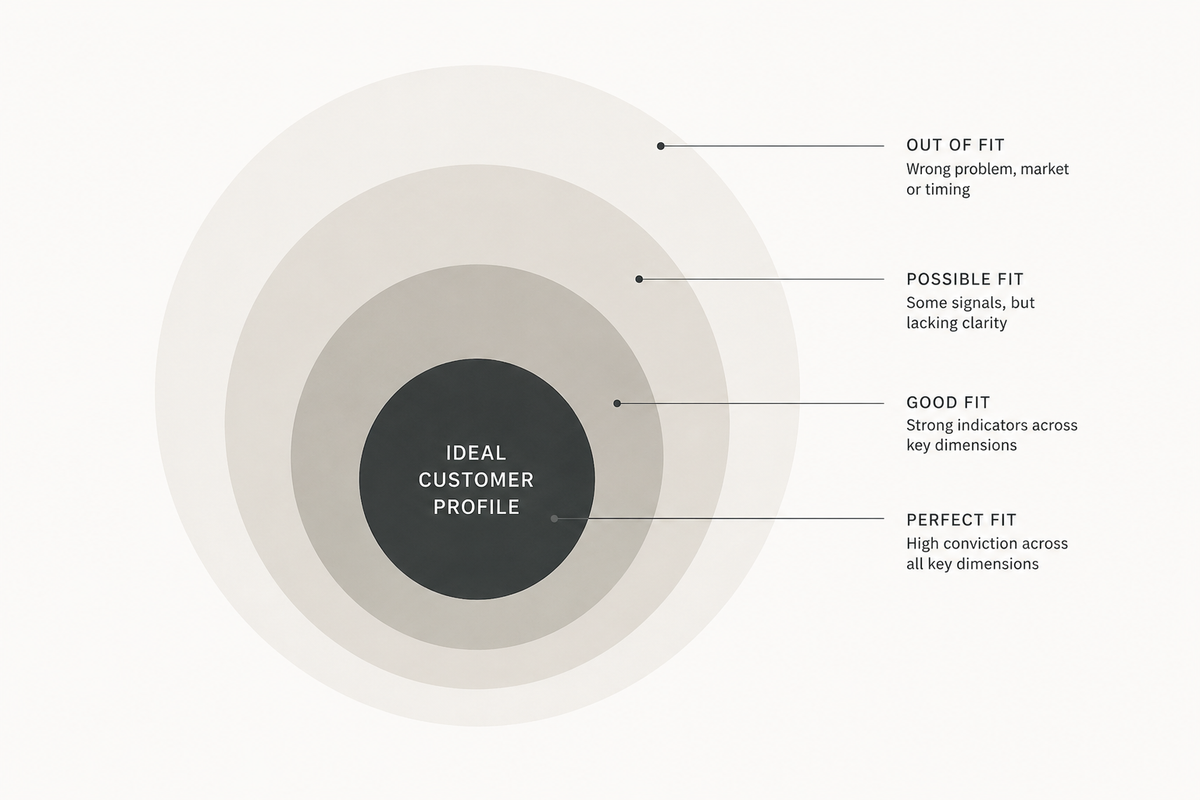
An ideal customer profile is an internal iterative hypothesis of the perfect customer for your products. It includes information like demographics, firmographics, exegraphics - buying signals, pain points and behaviours.
Think of it like the bulls-eye on a target. If you fire an arrow anywhere on the target you score but in the middle is where you get the most points. An ICP defines the criteria that allows you to hit the bullseye every time. And that's where you win.
What does a well defined ICP help with?
- Target the right people with the right message
- Avoid wasting time on low-fit leads
- Build a repeatable outbound motion
- Approach sales with an experimental, scientific mindset
Critically most ICP's I see really don't go into enough details. Firmographics alone are not enough. Most ICPs end up being too broad, too shallow and don't then help with targeting and messaging. Thats where exegraphics become essential.
What are exegraphics?
Exegraphics are the behavioural and operational characteristics that reveal how a company executes its mission - how they work, think, and prioritise. Think of exegraphics as the behavioural DNA of a business, how it executes its mission.
For example, two companies may both be 200-person SaaS businesses, but one operates with high urgency and outbound maturity while the other moves slowly and relies entirely on inbound. Firmographically similar, operationally completely different.
How do I research my Ideal Customer Profile?
In order to research your ideal customer profile we recommend breaking it down into 8 core sections.
Firmographics (industry, size, region, tools)
Exegraphics (how they operate, grow, and think)
Pain Signals / Triggers (what makes them need you)
Value Alignment (how you help them win)
Buying Committee (who’s involved in decisions)
Customer Journey Fit (how they buy and implement)
Negative ICP (who to avoid)
Evidence & Validation (proof your solution works)
What output am I aiming for?
The goal of this process is to build a practical, evidence-backed ICP hypothesis that can be used operationally across your entire revenue function.
At the end of this exercise you should have:
- A clear definition of your ideal customer
- A strong understanding of the problems they are trying to solve
- Insight into how they operate, buy and make decisions
- A repeatable outbound and targeting strategy
- Clear messaging angles that resonate with your market
- A better understanding of who you should avoid selling to
- A foundation for qualification, forecasting and downstream sales execution
Most importantly, you should leave with an ICP that is actionable.
—----
Below is a list of everything that should be thought about and researched to form an ICP hypothesis.
Hypothesis is a key word here. You are likely going to get this wrong to begin with. Using all the data below you should get close but ICP’s are iterative and need to be worked on as more data reveals itself. Think of this first iteration of the jumping off point on a never ending cycle.
Firmographics (industry, size, region, tools)
Definition: The measurable characteristics of your ideal company.
Examples:
- Industry: B2B SaaS, EdTech, Healthcare
- Company size: 100–500 employee
- Revenue: $10M–$100M
- Region: UK, US, ANZ
- Tech stack: GSuite, HubSpot, Zoom
Prompts:
- What industries are your best customers in?
- What team size or revenue range do you serve best?
- Are there tech stacks or platforms your product integrates with?
Exegraphics (how they operate, grow, and think)
Definition: The behavioural and operational characteristics that reveal how a company executes its mission - how they work, think, and prioritise.
Examples:
- Fast hiring velocity (e.g. growing SDR team quickly)
- High marketing-to-sales ratio
- Recently made hire
- Invests heavily in product innovation
- Data-driven decision-making culture
- Follows a PLG or outbound-led go-to-market motion
- Agile, early adopter mindset
- Strong emphasis on operational efficiency
Prompts:
- What behaviours or internal strategies do your best customers tend to share?
- Are they growing, hiring, or launching new initiatives?
- How do they typically approach go-to-market, product development, or decision-making?
Pain Signals / Triggers (what makes them need you)
Definition: Observable signals that indicate a customer is likely feeling pain within the problem space you solve for.
Examples:
- Team hiring rapidly
- Tech stack overhaul or CRM change
- Poor sales conversion rates
- Expansion into new markets
Prompts:
- What events or changes make a company realise they need you?
- What do struggling customers often have in common?
Value Alignment (how you help them win)
Definition: Where your product’s strengths match their strategic goals.
Examples:
- Focus on operational efficiency
- Need to improve onboarding or reduce churn
- Want better visibility into performance
Prompts:
- What big outcomes do your customers want?
- How do you help them achieve those goals?
Buying Committee (who’s involved in decisions)
Definition: The key roles involved in purchasing decisions.
Examples:
- Economic buyer: CFO, VP of Sales
- Champion: Sales Enablement Lead, Head of Ops
- Influencers: RevOps, IT
Prompts:
- Who usually signs off the deal?
- Who gets excited about the value?
- Who might block or delay the sale?
- What are the common objections?
Win/Loss data analysis (what can we learn from historic data)
Definition: Reviewing historical wins and losses to identify patterns in customer fit, buying behaviour, deal success and execution quality.
This is one of the most valuable parts of ICP development because your existing deals often reveal patterns you would never identify through assumptions alone.
Examples:
Common patterns in won deals
- Faster sales cycles
- Strong champion engagement
- High urgency around the problem
- Existing process maturity
- Strong operational buy-in
Common patterns in lost deals
- Weak qualification
- Low internal urgency
- No clear owner or champion
- Procurement-heavy organisations
- Poor implementation fit
- Selling too low in the organisation
Prompts:
- What characteristics do your best customers consistently share?
- Which types of deals close fastest?
- Which customers generate the highest retention or expansion?
- Where do you lose most often?
- What objections repeatedly appear in lost deals?
- Which customer types churn fastest?
- Which deals felt difficult throughout the process?
- Are there industries, company sizes or behaviours that correlate with success or failure?
Customer Journey Fit (how they buy and implement)
Definition: How well their buying process fits your sales process.
Examples:
- Already doing discovery-led sales
- Willing to adopt new tools
- Coachable, responsive team
Prompts:
- Do they buy software like yours already?
- Are they set up to implement and adopt it well?
Negative ICP (who to avoid)
Definition: Clear signs a lead is a bad fit.
Examples:
- 10 employees
- Founder-led sales with no sales team
- Uses only Microsoft tools and won’t change
- Procurement-led with 12-month cycles
Prompts:
- What types of customers do you consistently lose?
- Where do you churn fastest?
Evidence & Validation (proof your solution works)
Definition: Proof that companies like this get value from your product. (If you are just starting out look for external data points that help you evidence value)
Examples:
- Case studies
- Testimonials
- Benchmarks
- Win/loss reasons
Prompts:
- Who are your 3 best customers?
- What measurable results have you delivered?
We have several resources to support your initial ICP hypothesis generation.
Below is a link to our guide that will walk you through a series of questions around the core topics above. The output will then give you pretty much everything you need to define your first hypothesis.
Get the guide here --> https://blog.auditory.co/how-to-build-an-ideal-customer-profile-icp/
Alternatively you can use our custom GPT. This will walk you through all 8 sections and prompt where needed.
Access the GPT here --> https://blog.auditory.co/auditory-ideal-customer-profile-generator/
Note: This isn’t a tool that magically generates your ICP for you like some others claim.... It asks you smart, structured questions that get you thinking critically about who actually buys your product and why. It takes around 10–15 minutes to complete, and works best if you put in real thought.
What You Get at the End:
- A one-line summary of your ICP
- An estimated total addressable market (TAM)
- Suggested niches to explore within your ICP
- Ideas of places you could find your ICP and outbound strategy to go after them
- A cleaned-up version for your CRM or Notion
- Suggestions to improve weak or vague areas
It’s built on ChatGPT, so you’ll need an account to use it.