What is Positioning in B2B Sales? Examples, Mistakes & GTM Strategy
What is positioning in b2b sales?
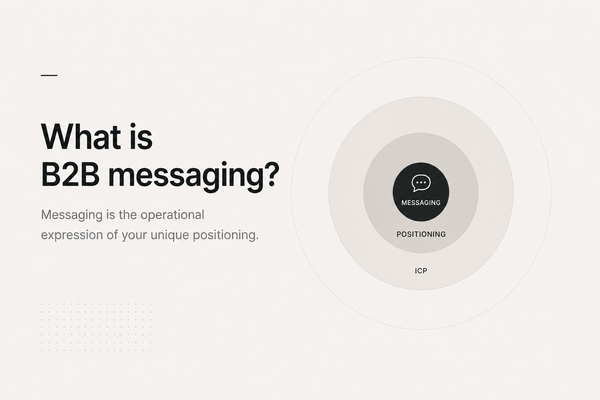
Positioning is the way in which a b2b company uniquely places itself within its market. It also showcases who you sell to and why you are different. It’s the infrastructure that ultimately informs your messaging, marketing and outbound approach.
Done correctly it creates clear differentiation between your product and your competitors. It can also create competitive advantages and moats that go beyond product features.
I’ll give you an example from my own experience.
When Accredible was a small company (<5 people and <$200K ARR) we were attempting to take on a Goliath in the credentialing space, Pearson’s Acclaim. Given our inability to outspend them we needed to beat them with a positional advantage.
Our positioning was simple: “Your brand should be the face of your digital credentials and therefore, whitelabelling of the credential recipient experience is a must when choosing a vendor”
Their counter position: “Our brand is well known and creates immediate trust and therefore you don’t need whitelabelling”
I am not saying that our positioning won every time (although it did help win Google, Snowflake, Skillsoft, Harvard, Berkeley, Oxford…. The list goes on as we grew to $15M+ ARR) but it did create a clear line in the sand between our product and our competitor which allowed us to build deep moats from a feature and philosophy perspective that made us stand out and unique in the space.
Another example. I caught up with Dor Vardi, CEO at Spear a few months back. I loved his positioning. He runs a sales outbound tool. But their positioning is that they are anti-spam. Why? Well his messaging is clear. His platform helps people target directly on triggers, so they send less but more relevant messages. They also lean into the human centric approach behind this. Strong counter positioning in a market that is being flooded by AI SDR companies claiming human SDRS are “dead”.
How is positioning different from messaging?
Positioning defines where you strategically fit in the market, messaging is the operational expression of that framing.
Famous examples from history:
Apple
Positioning: Premium, beautifully designed computers, for creatives and forward thinking people.
Messaging: “think different” - simple copy minimalist product launches.
Volvo
Positioning: Safest Family Car
Messaging: Crash test campaigns, Family orientated, seatbelt innovation, safety stats.
Hubspot
Positioning: Inbound marketing over interruptive outbound sales and marketing.
Messaging: Inbound frameworks, certifications, free tools and campaigns like “Stop interrupting people”
What does good positioning do?
Positioning isn’t just about differentiation. It can have huge effects on the downstream GTM motion when done effectively. It can change how buyers perceive your product offering, how well they respond to your outbound sales efforts, what objections surface, how quickly people understand your product's value and even whether or not they remember your brand at all.
What are the common mistakes people make when defining their positioning?
I always like to think that good strategy forces hard tradeoffs. Positioning is no different. If you try to create a position that is “catch all” you will fail. Trying to appeal to everyone is a fool's errand. I also advise against feature parity positioning ie: trying to prove you have the same features as competitors. Parity is not positioning. It’s not a moat and doesn’t provide a strong narrative. I also see lots of companies that end up with multiple positioning statements, sometimes even contradictory. It’s better to test one positioning strategy, iterate and pivot if needed than to try and push multiple narratives. Finally, pricing positioning, it can work but the reality is you are creating a race to the bottom where usually nobody wins.
How often should I update or review positioning?
I’ve mentioned a few times that positioning is usually a hypothesis and it’s an iterative process. Markets evolve, new competitors rise, buying patterns change. It’s imperative that positioning isn’t left to decay. In the early days of testing your positioning I would remain very close to it, trying different messaging/angles in order to hone in on a hypothesis that wins. As your positioning matures I would look to review this every 6 months to make sure you are testing your assumptions.
In closing…
You cannot ignore or overlook positioning. It’s a critical component to ensuring that your GTM motion is differentiated and has messaging that lands with your ICP. It creates clarity in your GTM strategy and its positive effects are felt downstream across the entire GTM motion.